Labels

Monday, 5 December 2016

Week 12 Reflection Post

Retrieved December 5th 2016 from: AdventurousChica


Hey guys! This is likely going to be my last math blog post for a while...we are getting ready to head into our placements, yay! (OK the thought is actually terrifying me) but I just wanted to talk about some of the things I have learned throughout the last 12 weeks.

I came into this math course unbelievably nervous that I was not going to do well because I would need to know how to do math...How wrong I was!!! I learned that you do not need to be a math whiz to be able to teach math, I've now learned through experience that it is OK to tell students "I don't know the answer to that right now but let me find it for you" or "why don't we find that answer together?". When I started teachers college I was so worried that teachers needed to know everything, that is the biggest misconception I could have had, teachers learn just as much as students do, we learn from each other.

I have learned through our assignments in this class that with a little bit of time and effort, putting together a lesson that is well organized and effective that you understand, is not all that difficult, sure it may seem daunting, but a little bit of time and effort goes a long way. I've also learned many tips and tricks for engaging students and having them learn while having fun! We have done things like Easter Egg hunts, number lines, and in my placement class we did a Pokemon Go scavenger hunt!

Throughout the past 12 weeks we have watched our classmates become more confident in their abilities as educators and it is because we have had great support with guidance through all the ways we can be effective in the classroom. Math is still a scary thought for me, I was speaking with a high school math teacher over the past weekend and listening to her talk about the projects her students were working on scared the pants off me. However, this doesn't mean that it is something I would not be able to do anymore, it just means I need to be flexible and have an open mind when it comes to myself and my students abilities in the classroom.

Thank you guys so much for reading over the last 12 weeks and I will try and keep you updated throughout my placement!


Saturday, 3 December 2016

Reflection 2

Which Professional Learning Goal would I want to emphasize during a job interview?

Policy:
Fundamental Principles

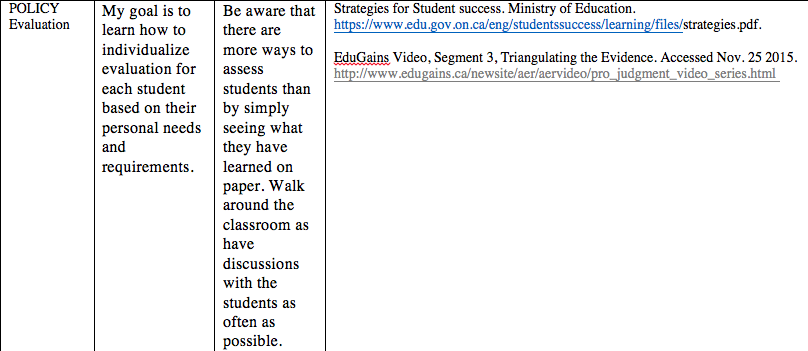
My learning goal is to ensure that all of my students have the opportunity provided to them as often as possible to succeed, not simply in school, but in life as well.
To achieve this goal, I must be attentive to each and every student in the classroom and make sure I am enabling them to do their best through differentiated instruction when it is necessary
Special Education in Ontario: 
Weber, K. J., and Sheila Bennett. Special Education in Ontario
 Schools. Seventh ed. St. Davids: Highland, 2013. Print.

Student Success Strategy.
http://www.edu.gov.on.ca/eng/teachers/studentsuccess/strategy.html

I would choose to emphasize this in a job interview because I feel like student success is the most important part of their education. Making every student believe that they are able and capable of achieving something is imperative to their continued effort and engagement. I have personally worked with a student in my placement on a math assignment and saw that he was struggling with a certain concept, as I worked through the problems with him and provided him with as many different tips and tricks as possible, he was successfully able to complete the task and his confidence was boosted tremendously. 

Reflection 1

Think about how you will use the Assessment page of your Digital Portfolio during your first teaching block. Provide 2 examples, 1 writing paragraph for each.

1) I plan to use my Assessment page of my Digital Portfolio in many different ways throughout my teaching block. To begin with, I believe it will be convenient to have so many useful resources all located in one easy place to find. The resources we have used throughout the year are fantastic for providing answers to possibly tricky questions or situations we may face in the coming weeks. I believe as educators it is important that we put in the most effort possible when it comes to being fair and just with our students so simply answering something we may be unsure of without checking the resources available to us is unfathomable to me.

2) I can also see myself using my Assessment page as a reminder that there are many steps to follow when assessing and evaluating students. The steps of the process have been laid out for us in our AER Strategy Form and allow us to reflect on how we are growing as educators; are we treating students equally or are we letting our personal bias' get in the way of being fair? It serves as a reminder that every student has the right to be successful and that we have set personal goals to achieve throughout our teaching block. This process is something that must be taken seriously because we are responsible for these students' future, molding them and shaping them and helping them to become the best that they can be.

Friday, 2 December 2016

AER Strategy For- EDBE 8Y01

Hey guys, take a look at this document to see some of the goals I will be setting for myself in my placement throughout the year!


Thursday, 1 December 2016

Week 11 Reflection- Effective Assessment in Math

Retrieved 

What a big week we had this week...we are winding down the semester with nearly all of our assignments done (yahoo!) and have finally now had a taste of what it is like to lesson plan. I don't know about everybody else, but I struggled with the assessment part of the lesson plan. I thought to myself, what is the point of teaching a lesson if we can't assess our students on it? 

My biggest challenge that I face when I think of assessment is being fair to all students and making sure that I am evaluating them all with the same opportunities and the same mindset based on their individual needs. We have learned over the last 12 weeks that there are three different levels of assessment. Assessment for, as and of learning...what are these, you ask? Let's take a look. 

Assessment FOR Learning
Assessment for learning is a form of assessment that is used to determine student progress. Teachers are able to adjust learning to the needs of the students and provide feedback. 

Assessment OF Learning
Assessment of learning is the use of a task or an in class activity to measure, record and report on a student's level of achievement. Are they getting it? 

Assessment AS Learning
This is a form of assessment that allows students to use assessment to further their own learning. Students can use this to reflect on their learning and to set personal goals for themselves. 

Something I did not realize coming into teachers college that assessing a students level of achievement could be so complicated! I think we all assume it's going to be nice and easy every day, that everything is going to go smoothly, but as I've started putting together lesson plans I have started to realize that could not be farther from the truth...I've got something else coming for me in the real world eh? 

The most important thing that we need to remember is that we need to be fair to all students, give every single one of them an equal opportunity to succeed. As educators, it is our job to mold and shape these children into who they are going to become. We will spend an extremely large chunk of their lives with them between the months of September to June so we better make sure that we ALL try our best. 

Thanks for reading again this week, that's me signing off. Toodaloo! 


via GIPHY

Sunday, 27 November 2016

Why is Oral Communication so Important?

Retrieved November 28th, 2016 From: Blogger

Why is it so important to teach Oral Communication to our youth? Being well spoken is a talent that requires much time and detail to conquer.  But we ask ourselves, why is it so important that we be well-spoken? Someone who is able to efficiently get their ideas from their head out into the open is someone who will go far in life. However, there is much more to it than simply being able to say what we are thinking, being able to do it in a well put together manner, being respectful of others, making sure our ideas are organized to make sense to others are all things one must learn how to do. 

The Ontario Language Curriculum states that, through talk, students not only communicate information but also explore and come to understand ideas and concepts; identify and solve problems; organize their experience and knowledge; and express and clarify their thoughts, feelings, and opinions. Ontario Language Curriculum Grades 1-8. (2006). 

How do we teach Oral Communication skills? Through modelling, through good listening, through debate and through as many open discussions as possible. Although speeches are less common today than they were when I went to school, I personally still find them to be an effective way to help with student confidence. No matter how front and centre technology becomes, Oral Communication will always be something that we need in life, going for an interview, speaking to a boss, a colleague, even a friend or a family member. It is so easy for us to just want to say whatever comes to mind however we need to take a step back and realize that an educated thought and verbal reaction will most likely have a better result than simply "word-vomiting" whatever comes to mind. 

I believe that many educators are afraid of encouraging Oral Communication in the classroom because it is easy to lose control of the class if you have a larger group. In my placement class, we have thirty one kids so maintaining order to get through the day is one of the toughest battles. Having strategically planned and well thought out classroom discussions is imperative to making sure you will not lose that class' attention. You want your students to be engaged in what they are talking about to promote as much participation related to the subject as possible. 

Listening skills go hand-in-hand with speaking skills...The Ontario Language Curriculum states that "students will: listen in order to understand and respond appropriately in a variety of situations for a variety of purposes".  How do we accomplish this? Having a respectful classroom environment is the starting point of good listening skills, no interrupting others while they are speaking, encouraging students to have silent time every day and having listening activities such as the game "Telephone" or one that we explored in our class last week called "Pass the Buck". These games force students to use their listening skills to be able to continue the story from where it left off. Playing games while learning, why not!? 


Retrieved November 27th, 2016 From: InnovAgility

Friday, 25 November 2016

Blog Post 2-Growing Success and Assessment

Assessment

Growing success the Kindergarten Addendum states that there are seven fundamental principles when it comes to assessment. It stresses that assessment should be fair and equitable for all students, it supports all students including those with special education needs, are carefully planned to relate to curriculum expectations, are communicated to both students and parents, are ongoing and varied in nature and help students develop their self-assessment skills to enable them to assess their own learning. Growing Success the kindergarten addendum and Growing Success have both helped me gain a better understanding of how to be conscious of following all of these criteria.

Evaluation and assessment must be fair and equal for all students so reading these documents has put an emphasis on how to be sure to be fair to all students and treat every student equally. each and every student needs to be asses according to their individual needs and as educators, I feel that it is mandatory to ensure we are putting as much effort into student assessment and evaluation as they are when they are submitting their work.

One thing we have learned over the last 11 weeks is that there are 3 different types of assessment, Assessment As Learning, Assessment For Learning and Assessment Of Learning. These are all different levels in which you will be assessing your students. What are they? Good question...

Assessment As Learning
In assessment as learning, students are active contributors. students are assessing themselves as they are learning. 

Assessment For Learning
This is a formative and diagnostic form of assessment. We are assessing something that can be changed if modifications needs to be made based on students levels of understanding. 

Assessment Of Learning
This form of assessment is summative. It is based on using exit cards from a lesson for example, to gain an understand of what students learned during the lesson. 

Reading the Growing Success documents has helped me become much more confident in my abilities to assess students and to know that there are many documents available to help with guidelines and understanding of certain areas if I am having trouble. 


Retrieved November 24th 2016 From: Pinterest